
Neurodivergent masking occurs when people adjust their natural behaviours, traits, or expressions to fit neurotypical expectations. This can involve:
- Suppressing stimming (e.g., rocking, tapping, hand-flapping).
- Mimicking social cues (e.g., facial expressions, tone of voice, or scripted conversation patterns).
- Forcing eye contact or adjusting communication styles to appear more neurotypical.
While masking can help individuals navigate work, education, and social situations, it often comes at a significant emotional cost.
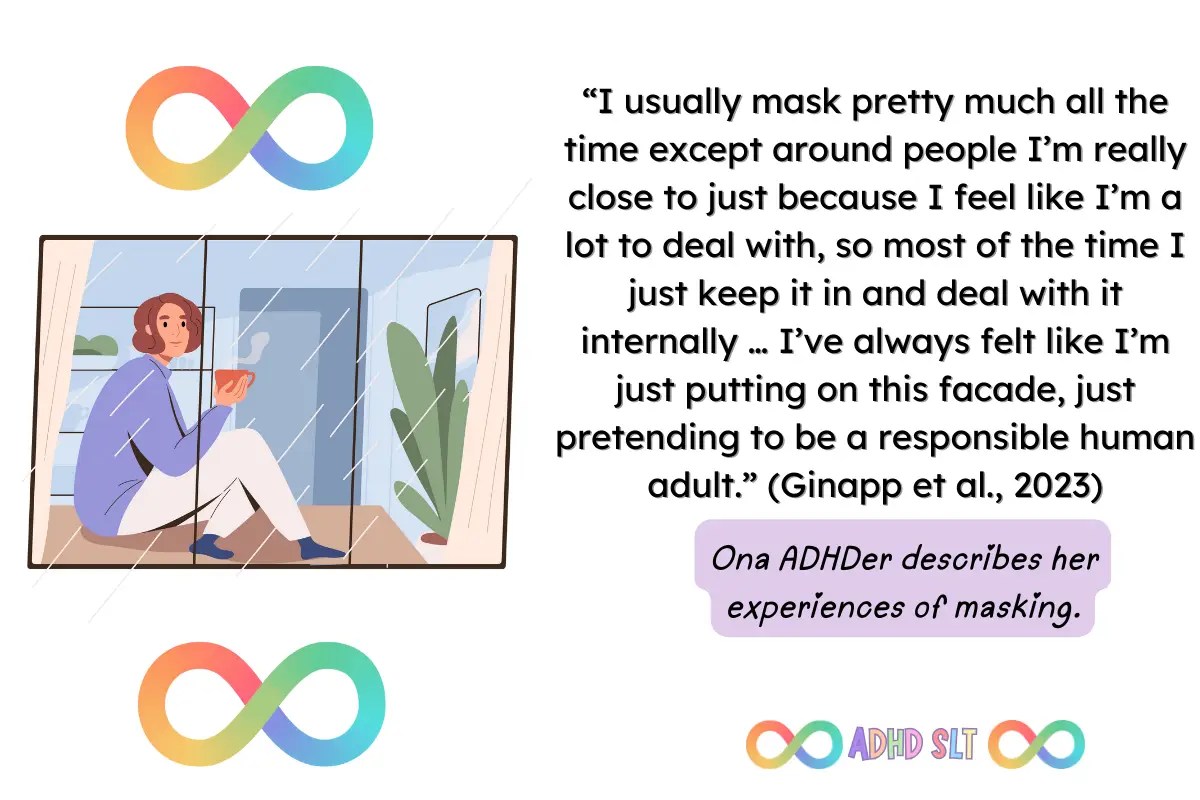
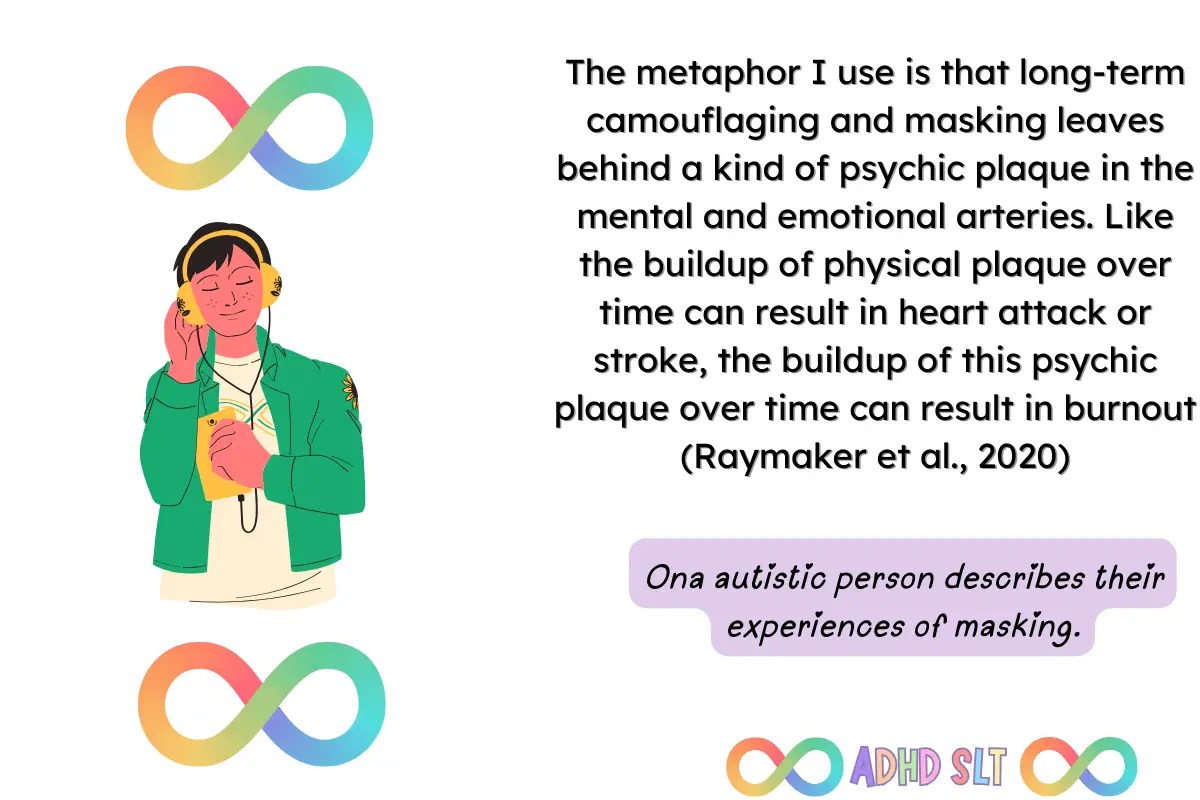
Why Do Neurodivergent People Mask?
Many neurodivergent people mask due to social expectations and stigma, including:
- Pressure to fit in: In school, workplaces, or social settings, people often feel they must act “typical” to be accepted.
- Avoiding judgement or rejection: Masking can be a response to past experiences of criticism or exclusion (Pearson and Rose, 2021).
- Meeting neurotypical norms: Individuals may alter speech, tone, facial expressions to avoid being perceived as “rude” or “different”. (Mylett, 2022).
Some people mask consciously, while for others, it becomes an automatic survival strategy.
What is Neurodivergent Masking?
neurodivergent masking
ADHD and Autistic Masking: How They Overlap
Both autistic and ADHD people experience masking, but it can manifest in different ways.
Autistic Masking:
- Mimicking neurotypical social behaviours – Copying expressions, tone, and phrasing to fit in.
- Forcing eye contact – Even when uncomfortable or unnatural.
- Hiding sensory overwhelm – Pretending bright lights, loud noises, or itchy clothing aren’t distressing.
- Scripting conversations – Memorising social phrases to avoid awkwardness.
- Suppressing stimming – Keeping hands still, avoiding rocking, or not using AAC (Augmentative and Alternative Communication).

ADHD Masking:

- Forcing themselves to focus – Using extreme mental effort to stay attentive, even when zoning out.
- Over-apologising & people-pleasing – Fearing rejection due to impulsivity or forgetfulness.
- Rehearsing what to say – Thinking ahead in conversations to avoid interrupting or rambling.
- Hiding executive dysfunction – Over-scheduling, using timers, or “hacks” to appear organised.
- Suppressing hyperactivity – Forcing stillness or fidgeting discreetly.
How Do ADHD & Autistic Masking Overlap?
Many people experience both types of masking, especially those who are AuDHD (both autistic and ADHD).
- Sensory overwhelm + impulsivity – Avoiding sensory discomfort while also managing ADHD-driven restlessness.
- Scripting + over-explaining – Using memorised conversation patterns while also over-explaining to prevent misunderstandings.
- Social exhaustion + hyperactivity – Feeling drained from masking while also needing to move constantly.
- Hiding both autistic and ADHD traits – Feeling the need to appear “competent” while struggling with executive function and sensory regulation.
AuDHD masking is common, yet many people don’t realise they’re doing it because they’ve done it for so long. This is why AuDHD individuals are often misdiagnosed or late-diagnosed, their ability to mask makes their struggles invisible to others.


the stigma around neurodivergence
Stigma surrounding neurodivergent traits plays a big role in masking. People are often:
👨🏻⚖️ Judged or excluded for behaviours that seem “different.”
👁 Criticised for stimming, sensory sensitivities, or communication differences.
‼️ Made to feel like their natural way of interacting is “wrong.”
The fear of judgement or rejection can push many neurodivergent individuals to mask, even when it negatively impacts their well-being. Furthermore, research has shown that neurotypical people ARE more likely to judge autistics (Sasson et al., 2017).
What is stigma?
Definition: Stigma
The Role of Social Media in Reinforcing Stigma
Social media has amplified the invalidating narratives surrounding neurodivergence, often shaming people into masking even more. Common dismissive comments include:
"Everyone has ADHD/autism these days."
"You're just looking for an excuse."
"People are self-diagnosing for attention."
"Back in my day, we just got on with it."
Ironically, this last comment often comes from a generation where ADHD and autism were just as prevalent, they simply weren’t recognised or diagnosed. Many of us have older parents or grandparents who struggle with transitions, changes in routine, social communication, or emotional regulation, yet refuse to acknowledge that these could be signs of neurodivergence.
What they fail to recognise is that a large amount of ADHD and autism is hereditary, meaning it likely came from them! Instead of dismissing younger generations, they might actually see themselves reflected in their children and grandchildren, if they were willing to look.
The Impact of Online Invalidation
Comments like these are not just opinions, they contribute to ableism.
- Shames neurodivergent individuals into staying silent about their struggles.
- Creates a hostile environment where people fear seeking diagnosis or support.
- Discourages self-advocacy, making it harder for people to unmask and be themselves.
- Promotes ableist narratives that dismiss neurodivergent identities as “trendy” rather than real.
🔴 Masking isn’t a choice, it’s often a response to stigma, rejection, and ableism. Instead of minimising neurodivergence, we need to shift the focus to education, acceptance, and dismantling the harmful stereotypes that keep neurodivergent people from getting the support they deserve.
The Emotional and Psychological Impact of Masking
Masking is mentally exhausting. Over time, it can lead to:
Low self-esteem: 🌧
Feeling like their true self isn’t “good enough” or acceptable.
Identity confusion: 💭
Struggling to know who they really are after masking for years. Furthermore, many report struggling to separate their “true self” from their “masked self”.
social exhaustion: 😪
The effort of constantly performing neurotypical behaviours can lead to shutdowns, meltdowns, and withdrawal.
High-masking neurodivergent people and burnout: 🔥
High-masking neurodivergent people often experience delayed burnout, as masking becomes so ingrained that distress is only recognised when it reaches a breaking point.Research shows that high-masking neurodivergent individuals are at greater risk of mental health struggles, late-diagnosed neurodivergence, and trauma responses (Pearson & Rose, 2021).


Hypervigilance: 🪞
Constantly monitoring their behaviour to avoid rejection or criticism.
difficulty trusting professionals: 👨⚕️
Experiencing therapy as something that reinforces shame rather than support. When therapy focuses on modifying behaviour instead of understanding individual needs, it can reinforce the idea that neurodivergent traits are “wrong.” This can make it even harder for people to unmask safely and embrace their identity.
trauma from therapy and forced compliance: 👨⚖️
For many neurodivergent individuals, trauma doesn’t just come from masking. It can also result from therapies that focus on changing behaviours rather than offering genuine support. See the ableist approaches page for more about this.


masking impact on daily life:
Masking is not just emotionally exhausting, it actively disrupts major areas of life. Occupational science, a field focused on human “doing” and belonging, frames camouflaging as an occupational disruption, meaning it interferes with daily tasks, relationships, and life participation (Franklin et al., 2024). Research highlights three key areas where masking causes significant disruption.
Work & Career:
Autistic women may struggle with burnout due to the cognitive load of masking in professional settings. Social expectations, sensory overwhelm, and the pressure to “perform” can lead to chronic stress and career instability.
Education:
Schools are designed for neurotypical students, leaving autistic students to mask their differences to fit in. This leads to missed support, undiagnosed struggles, and intense academic pressure.
Relationships & Social Life:
Many autistic women script conversations, suppress stimming, and force social interaction to avoid exclusion. This can cause deep exhaustion and identity confusion, leading to social withdrawal or burnout.
Franklin et al., (2024) highlight that masking is not simply a personal challenge, it is a structural issue. The more environments demand conformity, the more neurodivergent individuals are forced to expend cognitive resources to “fit in,” rather than simply existing as they are.
burnout
What is burnout?
Although neurotypical people can experience burnout, it often differs in impact and complexity from neurodivergent burnout (Hull et al., 2017). Neurotypical refers to someone without any form of neurodivergence. Below, we will explore the differences between neurotypical burnout and neurodivergent burnout, including their causes, impact, and recovery.

neurotypical burnout: 🧠
- Caused by stress, overwork, or high responsibilities with little rest (Kraemer, 2021).
- Usually relieved through temporary breaks, relaxation, and self-care.


Neurodivergent Burnout:⚡
- Predominantly caused by masking – The constant suppression of natural behaviours, social mirroring, and compensatory strategies leads to extreme exhaustion.
- More complex than neurotypical burnout – Not just from external stressors but from years of internalising expectations, forcing neurotypical behaviour, and suppressing struggles.
- Symptoms include shutdowns, emotional exhaustion, increased sensory sensitivity, and difficulty managing daily tasks (Guy-Evans, 2024).
- Breaks alone don’t fix it – Recovery requires unmasking, accommodations, and self-acceptance.
Why masking is the leading cause of neurodivergent burnout:
- Masking forces the brain to operate in a way that isn’t natural, leading to long-term cognitive overload.
- It suppresses sensory needs, social instincts, and emotional regulation, increasing stress and anxiety.
- Many neurodivergent people don’t realise they are burning out because masking becomes automatic.
- By the time burnout is recognised, it often results in complete shutdown, regression in functioning, or a long recovery period.
Important Note: 💡
Many high-masking neurodivergent individuals experience delayed burnout because they have spent years perfecting their ability to “perform” neurotypical behaviours, only realising the toll when it becomes unsustainable.
Why We Should Teach Kids About Masking
Research shows that many autistic and ADHD children begin masking in school, often without realising. They quickly learn that certain traits are “wrong” or “unacceptable”, leading them to suppress stimming, eye contact struggles, or hyperactivity to avoid bullying, punishment, or exclusion.
- Neurotypical children need to understand masking so they can recognise when their ND peers are struggling and create a more inclusive, accepting environment.
- Neurodivergent children need awareness to understand why they mask and that their natural ways of being aren’t wrong.


The Link Between Masking & School Experiences
- Neurodivergent children, especially autistic and ADHD children, are far more likely to be bullied.
- Masking is often a survival strategy to avoid being singled out.
- Early intervention & awareness could prevent unnecessary suffering, helping ND children feel safe enough to unmask and advocate for themselves.
Masking Begins in Childhood: The Need for Early Awareness
using spongebob to teach kids about masking
One way to explain neurodivergent masking to children is through the SpongeBob SquarePants episode “Not Normal.” This episode helps both kids and adults understand masking in a relatable way.
how 'not normal' illustrates masking
In this episode, SpongeBob changes his natural behaviour to fit what he believes is “normal.” After Squidward tells him he’s acting strangely, SpongeBob watches a video called “How to Be Normal for Beginners.” He starts suppressing his joyful, energetic personality and instead behaves in a subdued and restrained way.
While trying to meet the expectations of others, he loses his true self. SpongeBob becomes unhappy, exhausted, and disconnected from his best friend, Patrick. Eventually, he realizes that trying to be “normal” doesn’t bring him joy.


how this relates to masking
This storyline reflects neurodivergent masking, where people feel pressured to hide or change their natural behaviours to fit in. While masking can sometimes help individuals navigate social situations, it often leads to stress, burnout, and loss of identity.
Using relatable episodes like ‘Not Normal’ helps children understand masking on a deeper level.
teaching kids about masking can...
By teaching children about masking, we can:
- Reduce bullying and social exclusion of ND children.
- Help teachers & peers recognise distress, even when a child looks “fine”.
- Encourage neurodivergent children to feel safe expressing their authentic selves.
Masking in Girls & Women: The Gender Bias in Diagnosis
How Masking Hides Neurodivergence in Women
- Girls are socially conditioned to be “polite,” “quiet,” and “compliant”, leading many to develop strong masking skills from an early age.
- Women with autism or ADHD are more likely to present as “internalised” rather than “externalised”, meaning they may appear “shy,” “anxious,” or “perfectionistic” rather than hyperactive or obviously struggling (Mylett, 2022).
- The lack of research on neurodivergence in women means many are misdiagnosed with depression, anxiety, or BPD instead of being recognised as autistic or ADHD.


Missed & Underdiagnosed Neurodivergence in Women
Many women only realise they are neurodivergent in adulthood, after years of being misdiagnosed. Common misdiagnoses include:
Depression & Anxiety
While these conditions can co-exist, many women are told they have anxiety disorders without anyone considering that the root cause is undiagnosed autism or ADHD.
Borderline Personality Disorder (BPD)
Many autistic and ADHD women, especially those with emotional dysregulation, are misdiagnosed with BPD instead of autism (Mylett, 2022).
"You're just sensitive" / "You're just overthinking"
Women’s distress is often dismissed, and they are not taken seriously when they express struggles.
Medical Sexism & The Patriarchy in Diagnosis
The historical exclusion of women in medical research means:
- Most diagnostic criteria for autism & ADHD were developed based on young white boys.
- Doctors often don’t recognise ADHD & autism in women because they expect male-presenting traits (Craddock, 2024).
- Women are expected to mask more, meaning their struggles go unnoticed until they reach burnout.
- For women of the global majority – they are at even greater risk of misdiagnosis/missed diagnosis.


Why We Need Better Awareness of Masking in Women & Girls
- Masking in girls should not be mistaken for coping. Many girls excel in school but struggle immensely behind the scenes.
- We need better screening tools that consider how autism and ADHD present in women.
- Girls who mask are at higher risk of mental health issues, including eating disorders, self-harm, and suicidality.
- Late-diagnosed women often feel lost, invalidated, and exhausted after years of being misunderstood.
💡 Early awareness could prevent women from being dismissed, invalidated, and left without the support they need.


The Privilege of Unmasking: Who Gets to Be Themselves?
While unmasking is often framed as an act of self-acceptance, research highlights that unmasking is a privilege, not a universal possibility (Franklin et al., 2024).
Who gets to unmask safely?
- Many white autistic boys and men – the majority of research about Autism is about white males.
- Autistic white women in supportive networks.
- Neurodivergent individuals with strong community support.
- People in inclusive workplaces or social groups.
Who faces barriers to unmasking?
- Black autistic women & women from the global majority – Risk of facing racialised ableism, stereotypes of aggression, and lack of diagnostic recognition.
- Neurodivergent people in unsupportive families or workplaces – Unmasking can lead to job loss, medical dismissal, or family rejection.
- Autistic & ADHD individuals in conservative or highly structured cultures – Unmasking may result in social alienation, stigma, or discrimination.
- Asian communities face significant barriers in accessing ADHD and autism diagnoses due to cultural stigma, the “model minority” stereotype, and systemic healthcare biases (Asian American Mental Health, 2024). Many Asian families prioritize academic achievement and conformity, leading to masking neurodivergent traits to meet societal expectations. Additionally, language barriers and a lack of culturally competent healthcare providers make it harder for individuals to seek or receive an accurate diagnosis. As a result, many Asian neurodivergent individuals remain undiagnosed or misdiagnosed, delaying essential support and accommodations.
This means that telling someone to “just be themselves” ignores the reality that some people must mask to survive. The goal is not just for neurodivergent people to unmask, it’s to create a world where they don’t have to.


Rejection Sensitive Dysphoria (RSD)
RSD is a heightened sensitivity to real or perceived rejection, criticism, or disapproval (Dodson, 2017).
It can lead to intense emotional pain, shame, or even panic, sometimes in response to very small cues (a sigh, a silence, a look). RSD is especially common in ADHD, but many autistic people also describe similar feelings, even if they’ve never been given the term.
People with RSD may:
Mask to avoid upsetting or disappointing others
Avoid risks, even when they’re capable, out of fear of failure
Over-apologise, people-please, or overwork to feel “enough”
Experience social exhaustion from constantly second-guessing themselves
RSD is not just “being sensitive”, it’s a neurological response to a world that often misunderstands or invalidates neurodivergent communication and emotional expression.


Persistent Drive for Autonomy (PDA/Pervasive Drive for Autonomy)
Some neurodivergent individuals, often those labelled with Pathological Demand Avoidance (PDA) — have a deep, nervous system-level need for autonomy.
While the PDA label is still commonly used, many people prefer the term Persistent Drive for Autonomy or Pervasive Drive for Autonomy. (National Autistic Society, 2024). However, some still use pathological as a term as they feel that PDA is all-consuming.
This trait is not about defiance, it’s about safety.
When demands (even everyday ones like “get dressed” or “respond to this email”) feel like a threat to control or freedom, the nervous system can go into shutdown, meltdown, or panic.
People with a strong drive for autonomy may:
Mask in structured environments like school or work, but “explode” at home
Resist instructions, not out of rudeness, but from a felt sense of danger
Need to feel in control of how things happen — even small decisions
Use avoidance, humour, or distraction as coping tools
Be mislabelled as “difficult,” “oppositional,” or “manipulative”
When this drive is punished or misunderstood, it creates trauma, shame, and further masking. The world often demands compliance but for neurodivergent people with RSD or a strong drive for autonomy, compliance can feel like self-erasure.
This Isn’t a Personality Flaw — It’s Ableism
When neurodivergent people are taught to hide their needs and blamed for the impact of their traits, it leads to internalised shame, distress, and disconnection. This is not just about individual experiences, it’s part of a wider systemic issue.
What we often call “coping difficulties” or “behaviour problems” are actually responses to environments that do not accommodate neurodivergent needs.
This is ableism, and it’s time we called it what it is.
Not all masking is about fitting in socially, for many neurodivergent people, it’s also about avoiding rejection or protecting their autonomy in environments that feel unsafe or unpredictable.
When Rejection Sensitivity and Autonomy Collide
Next:
Learn how ableism shows up in education, healthcare, work, and even therapy, and why challenging it is vital for neurodivergent wellbeing.
reference by category:
ADHD, Autism & Burnout / Mental Health
Porto, T.I., Murgo, C.S., & Pereira, A. (2024). Prevalence and Correlations Between ADHD and Burnout Dimensions in Brazilian University Students. Paidéia (Ribeirão Preto).
Guy-Evans, O. (2024). ADHD Burnout: Signs, Cycle and Prevention. Simply Psychology.
Mylett, M. (2022). ‘I wish I could just be myself’: Social camouflaging, internalized stigma, and internalizing mental health problems in adult ADHD.
Kraemer, I. (2021). Autistic Burnout Is More Than Burnout. Autistic Science Person.
Autistic Masking & Camouflaging
Pearson, A. & Rose, K. (2021). A Conceptual Analysis of Autistic Masking: Understanding the Narrative of Stigma and the Illusion of Choice. Autism in Adulthood, 3(1), 52–60.
Hull, L. et al. (2017). ‘Putting on My Best Normal’: Social Camouflaging in Adults with Autism Spectrum Conditions. JADD, 47(8), 2519–2534. doi:10.1007/s10803-017-3166-5
Franklin, M.D. et al. (2024). An Occupational Science Contribution to Camouflaging Scholarship: Centering Intersectional Experiences of Occupational Disruptions. Autism in Adulthood.
Interpersonal Relationships, Victimisation & Abuse
Pearson, A., Rose, K., & Rees, J. (2022). ‘Professionals are the hardest to trust’: Supporting autistic adults who have experienced interpersonal victimisation.
Ginapp, C.M. et al. (2023). The experiences of adults with ADHD in interpersonal relationships and online communities. SSM – QRH, 3, 100223.
Douglas, S. & Sedgewick, F. (2023). Experiences of interpersonal victimization and abuse among autistic people. Autism, 28(7). doi:10.1177/13623613231205630
Guendelman, M.D. et al. (2015). Childhood ADHD Predicts Intimate Partner Victimization in Young Women. JACP, 44(1), 155–166. doi:10.1007/s10802-015-9984-z
Bancroft, L. (2002). Why Does He Do That? Berkley Books.
Evans, P. (2010). The Verbally Abusive Relationship. Adams Media.
Impact of Therapy / ABA
- Kupferstein, H. (2018). Evidence of Increased PTSD Symptoms in Autistics Exposed to ABA. Advances in Autism, 4(1), 19–29.
Social Perception & Interaction
Sasson, N.J. et al. (2017). Neurotypical Peers Are Less Willing to Interact with Autistics Based on First Impressions. Scientific Reports, 7(1), 1–10. doi:10.1038/srep40700
Hoza, B. (2007). Peer Functioning in Children With ADHD. Ambulatory Pediatrics, 7(1), 101–106. doi:10.1016/j.ambp.2006.04.011
Autistic Experiences of Eye Contact
Trevisan, D.A. et al. (2017). How Adults and Teens with Autism Experience Eye Contact. PLOS ONE, 12(11), e0188446.
Gender, ADHD/Autism & Intersectionality
Craddock, E. (2024). Being a Woman Is 100% Significant to My Experiences of ADHD and Autism. Qual Health Res, 34(14).
Slade, G. (2014). Diverse Perspectives [online] – Families from the global majority and autism support gaps.
Clerkley, K. (2022). The Underdiagnosis of ADHD in Black Females. CSUSB ScholarWorks.
Salih, T. (2023). Redefining Strengthens: Black Women Thriving with ADHD. Medium.
Asian American Mental Health (2024). Barriers to Diagnosis in Asian Communities. Anise Health.
RSD/PDA
- Dodson (2017). How ADHD Ignites RSD: Meaning & Medication Solutions. [online]
- National Autistic Society (2024). Demand avoidance. [online] http://www.autism.org.uk.