
Language
Communication and language are how we share thoughts, ideas, feelings, and information with others. Unlike speech, which focuses on sounds, language follows rules that give meaning to what we say, understand, read, or write. The five domains of language are: semantics, phonology, morphology, syntax and pragmatics.
It includes different forms and parts that work together to help us communicate clearly. In addition, many it can be aquired in two ways. Firstly, analytic language processing. The second way is known as as gestalt language processing. We will explore these more later.
forms of language
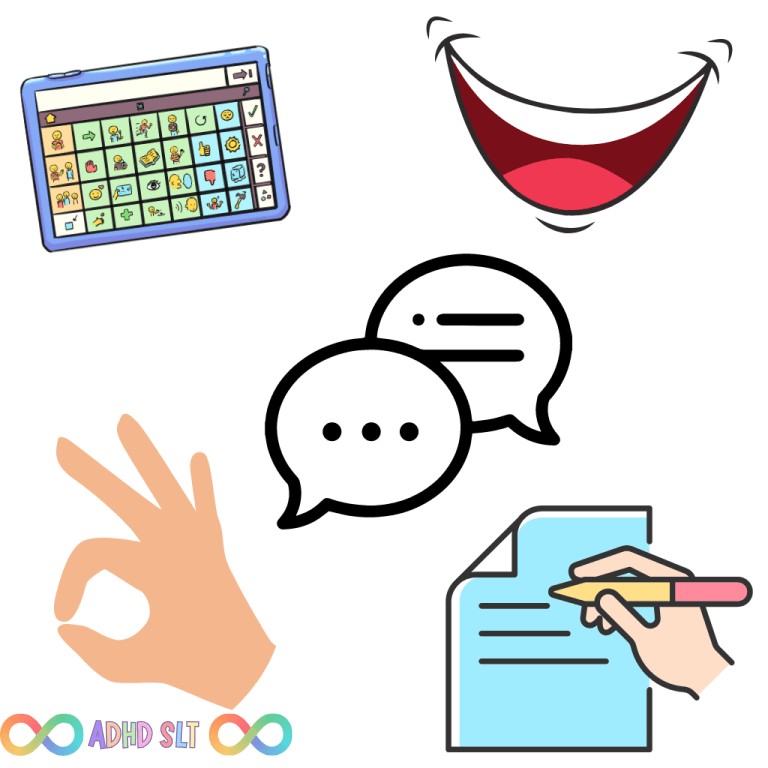
Communication can be spoken, written, or even signed. People often think of speaking first, but there are other ways to communicate, such as:
british sign language (BSL)
A visual language used by many deaf people in the UK.
Makaton
A simplified system using signs and symbols, often for people who need extra support to communicate.
written language
Used in books, emails, texts, and letters.
body language
Movements, gestures, and facial expressions that add meaning to communication.Understanding these forms shows how diverse language can be. No matter the form, the structure of language relies on key parts known as the five domains of language. Let’s explore them in more detail.

Analytic Language Processing
Children learn language by being surrounded by it—through exposure, imitation, and interaction with others. For many children, this happens through a process called Analytic Language Processing.
How Does Analytic Language Processing Work?
Analytic Language Processing involves breaking down what children hear into smaller parts, like individual words or sounds. Over time, they piece these parts together to form sentences. For example, a child might start by babbling, progress to saying individual sounds, then words like “mama,” and eventually phrases and full sentences.
This is the traditional way many people think about how children acquire language (Harris, 2024).
Do All Children Learn Language This Way?
No, not all children process language in the same way. Research by Ann Peters (1985) and Barry Prizant (1983) identified two main styles of language learning: analytic and gestalt.
- Analytic processing involves breaking language down into smaller components.
- Gestalt processing involves learning language in larger chunks or phrases.

What Is the Connection to Echolalia?
Barry Prizant’s research found that many autistic children use delayed echolalia—repeating phrases or sentences they’ve heard—as a natural part of their language development. This reflects a more gestalt approach, where children process language as whole units instead of breaking it into individual words.
The Role of Marge Blanc’s Natural Language Acquisition (NLA)
Marge Blanc, a respected speech-language pathologist, expanded on this concept through her Natural Language Acquisition (NLA) framework. Blanc emphasized that echolalia is not a “problem behavior,” but an essential part of language development for gestalt learners. Her neurodiversity-affirming practices have shifted perspectives in speech therapy, promoting understanding and acceptance of children who learn through gestalt processing (Blanc, 2012).
What Is Gestalt Language Processing?
Now that we’ve covered analytic processing, it’s time to explore Gestalt Language Processing. This approach, its stages, and how it differs from analytic processing provide valuable insights into how different children develop language.
To learn more about this fascinating process, visit the Gestalt Language Processing page or check out the Neurodiversity Hub on my site. If you’re looking for personalized support or guidance, feel free to contact me directly.
References by category
Autism and Language Development
- Ahtam, B., Braeutigam, S. and Bailey, A. (2020). Semantic Processing in Autism Spectrum Disorders Is Associated With the Timing of Language Acquisition: A Magnetoencephalographic Study. Frontiers in Human Neuroscience, [online] 14, p.267.
- Blanc, M. (2012). Natural language acquisition on the autism spectrum: the journey from echolalia to self-generated language. Madison, Wi: Communication Development Center.
- Prizant, B.M. (1983). Language Acquisition and Communicative Behaviour in Autism. Journal of Speech and Hearing Disorders, 48(3), pp.296–307.
- Milton, D. (2012). On the ontological status of autism: the ‘double empathy problem’. Disability & Society, 27(6), pp.883–887.
Gestalt Language Processing
Developmental Language and Communication Disorders
- Mengisidou, M., Marshall, C.R. and Stavrakaki, S. (2019). Semantic fluency difficulties in developmental dyslexia and developmental language disorder (DLD): poor semantic structure of the lexicon or slower retrieval processes? International Journal of Language & Communication Disorders, 55(2).
- Moraleda-Sepúlveda, E. and López-Resa, P. (2022). Morphological Difficulties in People with Developmental Language Disorder. Children, 9(2), p.125.
- Stringer, H. (2021). Phonological awareness. What comes before letters and sounds: Getting children ready for phonics. [online]
ADHD and Social/Interpersonal Impacts
- Ginapp, C.M., Greenberg, N.R., MacDonald-Gagnon, G., Angarita, G.A., Bold, K.W. and Potenza, M.N. (2023). The experiences of adults with ADHD in interpersonal relationships and online communities: A qualitative study. SSM – Qualitative Research in Health, [online] 3, p.100223.
General Language Acquisition
- Frawley, W. and Peters, A.M. (1985). The Units of Language Acquisition. Language, [online] 61(1), p.235.
SEMANTICS
what is semantics?
Semantics is all about the meaning of words and sentences. It involves understanding what words mean and how they work together to create meaningful phrases or sentences. For instance, knowing that the word “bank” can refer to the edge of a river or a financial institution, depending on the context.
vocabulary
A person with semantic difficulties might have a smaller vocabulary or struggle to understand the meanings of words. This can make it hard to follow conversations, understand instructions, or comprehend what they read. They might know certain words but have trouble recalling them when needed. As a result, they often rely on vague terms like “thing” or “stuff.”
Recognizing word meanings and grouping them into categories, like knowing that “banana” and “apple” belong to the “fruit” category, is an essential skill for learning and communication. This process, called semantic categorization, helps us organize and store vocabulary efficiently. As a result, it becomes easier to recall words when needed.
word-finding
Semantic categorization also helps us see connections between words. This supports vocabulary growth, improves comprehension, and allows us to form more complex sentences. By understanding categories, we can better describe, explain, and make sense of the world around us. Therefore, it can lead to clearer and more effective communication.


Why Figurative Language Can Be Confusing
Figurative language, like idioms or metaphors, can be confusing for some people. For instance, they may take phrases like “break a leg” literally, not understanding the intended meaning. Additionally, they might also struggle with words that have multiple meanings or with recognizing relationships between words, such as synonyms, antonyms, or categories. As a result, this can make processing and using language effectively much more difficult.
Who Might Struggle with Semantic Tasks?
autistic people
Some autistic individuals may find it challenging to interpret non-literal language, idioms, metaphors, or words with multiple meanings. This can make it harder for them to understand language in different contexts (Ahtam, Braeutigam, and Bailey, 2020).
People with Developmental Language Disorder (DLD)
People with DLD may struggle with tasks that involve semantic fluency. However, their difficulties do not come from a flawed understanding of word meanings. Instead, they have slower retrieval processes, meaning they take longer to access and use words even though they understand them (Mengisidou, Marshall, and Stavrakaki, 2019).
By recognizing these challenges, we can better support individuals in improving their understanding and use of language.


Morphology
Morphology focuses on the structure of words and how they are made up of smaller units called morphemes. A morpheme is the smallest part of a word that carries meaning. For example, the word “unhappiness” has three morphemes:
- “un-” (meaning “not”)
- “happy”
- “-ness” (meaning “state of”)
The role of morphology in communication
Morphology plays a key role in grammar, word formation, reading, and writing. When someone has difficulty with morphology, they may struggle to:
- Use correct past tense endings (like “-ed”)
- Form plurals correctly (like “-s”)
- Understand and use complex words
- Decode and spell words accurately
These challenges can lead to sentences that sound incomplete or incorrect. They can also make reading and writing more difficult.
Who Is Affected by Morphological Difficulties?
There is a strong link between Developmental Language Disorder (DLD) and difficulties with morphology. These challenges can significantly impact communication and language development (Moraleda-Sepúlveda and López-Resa, 2022).
By understanding these difficulties, we can better support individuals in developing stronger language skills.
(Check out the images below for more ideas—click to enlarge if needed!)


pragmatics
Pragmatics is about how we use language in social situations. It focuses on adapting communication based on the context, social rules, and the person we’re speaking to. Examples include:
🕘 Turn-taking in conversation. (May not look the same for neurodivergent people!).
🤫 Recognising non-verbal cues.
🏫 Adjusting language for different settings, e.g. speaking diferently to a teacher than a friend.
The Traditional Approach to Teaching Pragmatics
Traditionally, teaching pragmatics has centered on enforcing “correct” or “socially acceptable” communication. As a result, many neurodivergent people feel pressured to fit neurotypical norms. Furthermore, many neurodivergent people find this invalidating, leading to masking their natural communication style
A Neurodivergent-Affirming Approach to Pragmatics
As a neurodivergent-affirming therapist, I take a different approach based on respect and authenticity. Instead of enforcing rigid social rules, I help individuals develop skills such as:
- Perspective-taking: Understanding different viewpoints
- Self-advocacy: Expressing personal needs and preferences
- Authentic communication: Finding ways to communicate naturally and comfortably
This approach helps individuals connect without masking or hiding their true selves. It promotes authentic communication and acceptance.

Who Might Experience challenges with pragmatic communication?
Autistic people
Autistic people may experience challenges with:
- Inferencing
- Understanding and using emotion words (alexithymia).
- Using eye contact – this can be painful for some autistic people.
These differences are not flaws. Rather, they reflect a mismatch between autistic and neurotypical communication styles, as explained by the Double Empathy Problem (Milton, 2012).
ADHDERS
For people with ADHD, social challenges often relate to:
- Emotional regulation and using/understanding emotion words.
- Impulsivity – may lead to difficulties understanding ‘rules’ of waiting for their turn to speak.
- Use of coherence
These challenges may cause misunderstandings, but they do not stem from deficits. Many ADHD individuals easily connect with others who share similar traits. The real issue often lies in external misunderstandings or a lack of acceptance from others (Ginapp et al., 2023).
developmental language disorder (DLD)
People with DLD may struggle with:
- Understanding social cues – Difficulty interpreting body language, tone, or facial expressions.
- Conversational turn-taking – Challenges with knowing when to speak or listen.
- Staying on topic – Struggles with maintaining or transitioning between topics.
- Processing delays – Taking longer to understand and respond.
- Understanding figurative language – Difficulty with idioms, sarcasm, and indirect language.
Other Conditions That Can Impact Pragmatic Language:
- Down Syndrome – May affect expressive language and social reciprocity.
- Hearing Loss – Can impact access to verbal language and social interaction.
- Social (Pragmatic) Communication Disorder (SCD) – Specifically affects understanding and using language in social contexts.
- Traumatic Brain Injury (TBI) – Can alter social communication and processing.
- Situational Mutism – Anxiety-related challenges with verbal communication in specific settings.
Pragmatic language difficulties do not indicate a lack of intelligence or willingness to communicate—they often stem from external misunderstandings rather than internal deficits.

syntax
Syntax is the set of rules that tells us how to arrange words to form sentences that make sense. For instance, we know that “The cat chased the mouse” is correct, but “Cat the mouse chased” is not.
the role of syntax in communication
When someone struggles with syntax, they may have trouble forming or understanding correct sentences. Consequently, their speech can sound jumbled or incomplete. AS an example, they might say, “She school went” instead of “She went to school.”
These challenges can also impact grammar. For example, someone might use incorrect plurals, tense endings, or word forms in sentences.
how can sytax issues be addressed?
One evidence-based approach to improving sentence structure is Colourful Semantics. This method helps break down sentences and build them step by step. In addition, it is especially useful for teaching correct sentence formation and grammar. See below for a preview of Colourful Semantics:

who might struggle with syntax?
Difficulties with syntax are common in several conditions:
Developmental Language Disorder (DLD):
People with DLD often have trouble forming or understanding sentences (Hestvik et al., 2022).
Autism:
Some autistic individuals may find sentence construction challenging (Stockbridge, Happé, and White, 2013).
ADHD:
ADHD: People with ADHD can experience issues with syntax, especially when processing language or organizing thoughts (Hawkins et al., 2016).
Understanding syntax is key to effective communication, and targeted support can help individuals improve their sentence structure over time.